
Kids' Bedroom Storage Ideas: Hooks, Pegs and a Cosy Reading Corner
Kids' bedroom storage ideas that children can actually use: hooks at their height, fun coat racks, toy baskets, small-room tips and a cosy reading corner.
On this page
Summary The best kids' bedroom storage is low, simple and fun to use: hooks and pegs at a height your child can reach, baskets they can lift on their own, and one clear home for each type of thing. Plan the room in small zones, keep the floor free, and add a cosy corner that makes tidying up worth it.
Children's rooms fill up fast: school bags, coats, dressing-gowns, soft toys, books and that one hat that is never where it should be. The trick is not more storage, but storage a child can actually use without help. This guide covers how to plan the room, which hooks and racks work best, ideas for small bedrooms and shared rooms, and how to make a reading corner your child will love.
Plan the room in small zones
Give every type of thing its own zone, and keep each zone at your child's height.
- Getting dressed: a few hooks for tomorrow's clothes, a dressing-gown and a coat, close to the wardrobe or chest of drawers.
- School: one hook for the school bag and one for the PE bag, near the door so nothing is forgotten in the morning.
- Play: baskets and boxes on the floor or on low shelves, sorted by type of toy.
- Quiet time: a reading corner with books on show, a cushion and soft light.
Walk around the room at your child's eye level before you buy anything. If they cannot reach it, they will not use it, and things will end up on the floor again.
Zones and storage at a glance
| Zone | What lives there | Storage that works | Where |
|---|---|---|---|
| Getting dressed | Dressing-gown, coat, tomorrow's clothes | 3 to 5 hooks or a small coat rack | Near the wardrobe, 90 to 110 cm from the floor for ages 5 to 7 |
| School | School bag, PE bag | Two hooks or pegs | Near the door |
| Play | Toys sorted by type | Baskets, boxes and low shelves | On the floor and the lowest shelves |
| Quiet time | Books, cushions, soft toys | A book ledge with covers on show, two or three hooks for a book bag | A corner away from the door, with daylight |
| Small treasures | Keys, lanyards, bracelets | A small rack such as the wooden village key rack | At your child's height: 110 to 130 cm for ages 8 to 11 |
| Out of season | Spare bedding, toys on rotation | Rolling boxes | Under the bed |
These are the heights we suggest. The top of each range is close to the average height of the youngest child in the age band, about 110 cm at five and about 127 cm at eight, so children can reach with a raised hand.
Hooks at child height

Wall hooks are the quickest way to get coats, bags and dressing-gowns off the floor, and fun designs make children want to use them. Our kids’ coat hooks guide gives the right height and spacing.
Animal and dinosaur hooks turn tidying up into a small game: the bag goes on the bear, the dressing-gown on the T. rex. For a whole room on the theme, see our dinosaur bedroom ideas. A few ideas from our kids' coat hooks:
- Animal faces: the wooden animal face wall hooks come as a kitten, bear, panda, piglet or rabbit. They are sold one by one, so each child can choose a favourite, or you can line up the whole family of animals.
- Dinosaurs: the wooden dinosaur wall hook comes as a T. rex, a long-neck dinosaur, a stegosaurus or a crocodile, with an adhesive pad for smooth walls.
- Animal pegs: the wooden animal peg hooks come as a bear, a cat, a calf or a chicken, with a round peg that holds a bag or a coat, single or as a set of two.
- Turtles: the wooden turtle wall hooks come in sets of two or three, in Light Shell or Walnut Finish Shell, and look just as good in a bathroom for towels.
We suggest hanging hooks at around 90 to 110 cm from the floor for most children, close to the average height of a five-year-old, a little lower for toddlers, and moving them up as your child grows. We also suggest about 15 cm between hooks so a coat and a bag do not overlap.
Coat racks and peg rails for kids

A rack puts several hooks on one board, so there is only one thing to fix to the wall and the spacing is already done.
- For dinosaur fans: the dinosaur coat rack for kids has four green dinosaurs on a 40 cm wooden board, as long-neck dinosaurs or little T. rex.
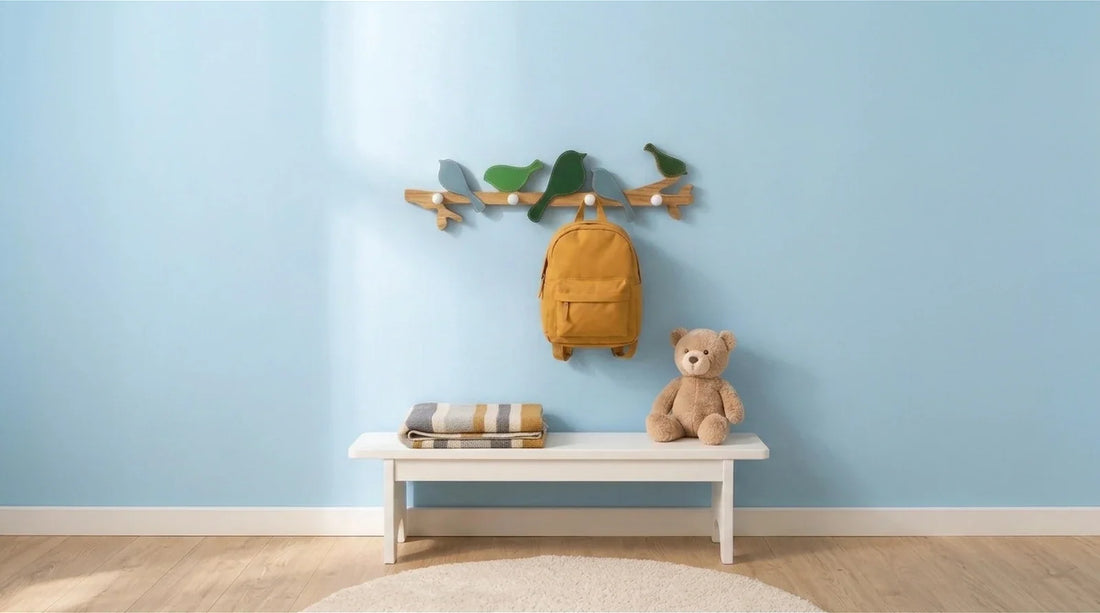
- For nature lovers: the wooden bird branch coat rack has five painted birds on a 47.5 cm branch, in colourful or green tones.
- For music lovers: the colourful piano key coat rack looks like a keyboard with rainbow keys. The hooks fold down when needed and fold back flat when not, so nothing sticks out in a busy room. It comes in 30, 40 and 50 cm.
- For bright colours: the colourful wave coat rack for kids is a single wavy line where every curve is a hook: 30 cm with 3 hooks or 40 cm with 4, in blue, red, orange or pink. In a shared room, give each child their own colour.
A rack with four to five hooks is usually enough for one child: coat, school bag, PE bag, dressing-gown and a spare for a hat or a costume.
Toys, books and baskets

Keep toy storage low and open, with containers your child can carry.
- Baskets and boxes: one type of toy per basket, with a picture label for children who cannot read yet.
- Low shelves: put the favourite toys at the bottom and keep the top for things that need an adult.
- Front-facing books: a book ledge or a low shelf with covers on show lets children choose a book by its cover.
- Rotate toys: keep some toys in a box under the bed and swap them every few weeks. Fewer toys out means less to tidy.
Storage ideas for small kids' bedrooms

In a small bedroom, use the walls and the back of the door, and keep the floor as clear as possible.
- Go vertical: a row of hooks or a coat rack frees floor space that a freestanding stand would take.
- Behind the door: slim hooks for dressing-gowns and bags keep them out of sight.
- No drilling: adhesive hooks such as the rainbow, cloud and raindrop hooks work well on smooth painted walls, tiles and glass for light items, and are handy in rented homes.
- Under the bed: rolling boxes for spare bedding, out-of-season clothes and toys on rotation.
- Fold-flat hooks: a rack with folding hooks, such as the piano key design, stays flat against the wall when it is not in use.
Make a cosy reading corner

A reading corner gives the room a calm spot, and gives books, cushions and soft toys a place of their own.
Pick a corner away from the door, with good daylight. Add a soft rug, a pile of cushions and a low shelf or ledge for books with their covers on show. For a little hideaway feel, a kids' teepee turns the corner into a den where children love to curl up with a book.
Fix two or three animal hooks on the wall next to the corner for a book bag, a blanket or a favourite costume, so everything for quiet time stays together.
Shared bedrooms

When children share a room, give each one their own hooks, their own basket and their own colour or animal.
- Choose one animal hook per child, so everyone knows which hook is theirs.
- Split the wall in two and hang each child's hooks at the right height for their age.
- Keep a shared zone for toys and books, and a personal zone for clothes and school things.
Fitting and safety

Children pull on hooks and racks, so fix them firmly and check them from time to time.
- Use a detector to check for pipes and cables before drilling.
- Use wall plugs that suit your wall; on plasterboard, fix into a timber stud or use cavity fixings. Our guide How to Fix a Coat Rack to Plasterboard shows how.
- Keep adhesive hooks for light items on smooth, clean surfaces.
- Do not fit hooks next to a cot or a bed where a child could climb, and keep long cords and drawstring bags out of reach of babies and toddlers.
- We suggest checking the fixings every few months, especially on hooks children pull on.
For more on heights and spacing, read How High Should Coat Hooks Be?
FAQ
How can I get my child to tidy their bedroom?
Make storage easy to reach and easy to use: hooks at their height, open baskets and picture labels. Fun designs, such as animal or dinosaur hooks, also help children want to put things away.
What height should coat hooks be in a child's bedroom?
We suggest around 90 to 110 cm from the floor for most children, close to the average height of a five-year-old, and a little lower for toddlers. Raise them as your child grows.
How do I add storage to a small kids' bedroom?
Use the walls and the back of the door with hooks and racks, add rolling boxes under the bed, and keep only part of the toys out at a time.
Are adhesive hooks safe in a child's room?
They are fine for light items such as a hat, a small bag or a towel on a smooth, clean surface. For coats and school bags, choose hooks fixed with screws and wall plugs.
Shop Kids' Coat Hooks
See all-
Colourful Piano Key Coat Rack for Kids
Regular price£38.99Black Friday price From £33.14 Save 15% -
Dinosaur Coat Rack for Kids, 4 Hooks
Regular price£31.99Black Friday price £27.19 Save 15% -
Rainbow, Cloud and Raindrop Adhesive Wall Hooks
Regular price £9.99Save 15% on orders of £30+ -
Regular price From £26.99Save 15% on orders of £30+


